Welcome to the official website of Kolorapus (Shanghai) Communication Technology Co., Ltd.!


-
-
Product
-
-

-
-
-
Large-scale 5G deployment is inevitable—so which industries will benefit?
2022-05-16
When will 5G networks be launched? Wang Zhiqin, deputy director of the China Academy of Information and Communications Technology, told a reporter from Economic Reference News that many countries and regions are now placing great importance on the commercial deployment of 5G. The United States, the European Union, South Korea, Japan, and China all plan to begin commercial deployment of 5G networks in the second half of 2019 and officially launch commercial services in 2020. With the publication of the international 5G standards, global competition in the 5G industry will intensify further. According to the Ministry of Industry and Information Technology and the three major telecom operators, China’s commercial rollout of 5G is progressing smoothly and steadily. Technical R&D trials have officially entered their third phase. It is expected that by the end of 2018, key segments of the 5G industrial chain will largely reach pre-commercial readiness levels. Plans call for starting 5G network construction in 2019 and officially launching commercial 5G services in 2020.
In the coming years, the 5G market is expected to exceed 100 billion U.S. dollars. Considering the technological characteristics of 5G and the resulting industry changes, the following sectors will directly benefit: base station equipment, optical modules, fiber optic cables, antennas, and small cell base stations. Investors can consider deploying capital along these key areas:
1) Operator:
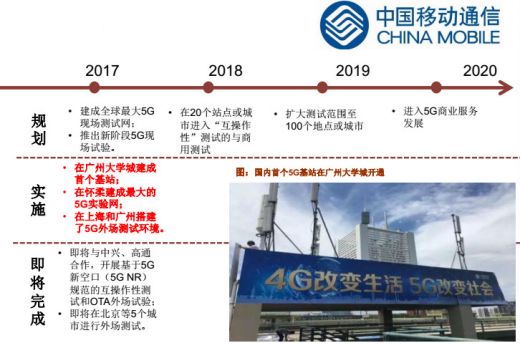
China Mobile, in collaboration with Qualcomm and ZTE, has launched 5G technology testing and experimentation. This year, China Mobile has planned the first batch of cities for 5G trial network construction, namely Beijing, Shanghai, Guangzhou, Ningbo, and Suzhou. Next year, the scale of these tests will be further expanded to validate the networking capabilities of 5G networks. Additionally, in 2019, China Mobile will conduct large-scale pre-commercial trials of 5G, and commercial deployment is expected to be achieved by 2020. China’s 5G technology is internationally leading, having already introduced the first prototype and the first commercially available 5G device. The 5G network architecture proposed and led by China Mobile was incorporated into the international 5G network architecture standard this past May. It can be said that China is spearheading global research and standardization efforts in 5G technology.
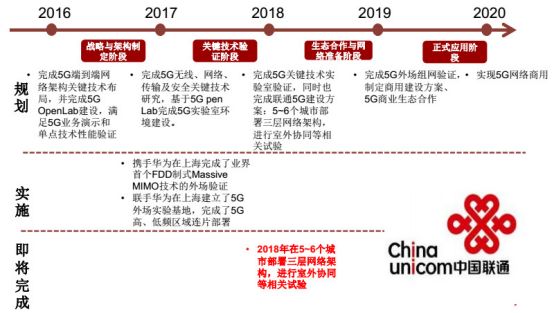
China Unicom’s 5G field trial base is located in Shanghai. China Unicom, in collaboration with Huawei, has established the first 5G field trial base, where various technical solutions—including 5G coverage, mobility, high- and low-frequency spectrum integration, and uplink spectrum sharing—are being tested and validated. In the future, China Unicom will also conduct commercial validation of 5G products in Shanghai. Furthermore, China Unicom stated that it is currently cooperating with numerous domestic and international companies to set up 5G laboratories and plans to accelerate the commercial deployment of 5G technology.
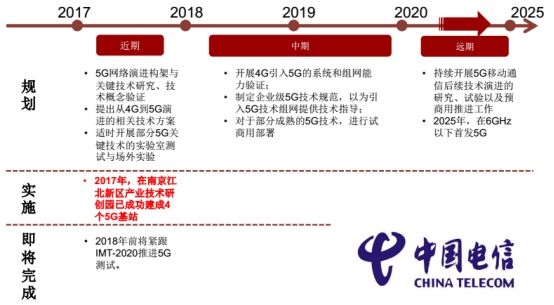
China Telecom has already completed the construction of four 5G base stations in Nanjing, and plans to add 600 more 5G base stations within the Nanjing area in the future. China Telecom is conducting research and testing on 5G technology, with its initial 5G network operating in the sub-6 GHz frequency band. By 2025, the company aims to promote the practical application of 5G technology. Meanwhile, in the Xiong'an New Area, China Telecom is providing full coverage for Tianyi 4G and NB-IoT, and has proactively laid out a 5G trial network.
2) Core Equipment: Wireless and network equipment suppliers are the key beneficiaries with certainty, and as Chinese companies enhance their leadership in standards, this will boost the participation of the entire domestic industrial chain in the global 5G ecosystem.
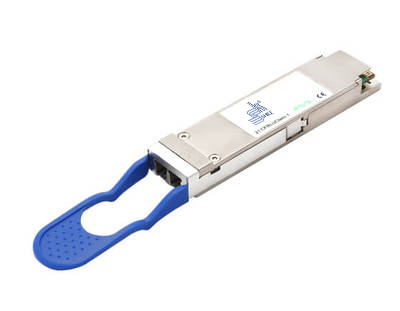
3) Optical Modules/Optical Components: The increase in the number of base stations and the upgrade to 5G technology will lead to a dramatic leap in both the quantity and data rates of optical modules used for inter-base-station connections. While 6G optical modules—each capable of handling six channels—are widely deployed in 4G base stations, the 5G era will see a full-scale upgrade to 25G/100G optical modules, with the number per base station reaching as many as 20 units. Moreover, data centers will benefit from 5G, driving demand for high-speed optical modules. Optical module manufacturers will fully reap the benefits of 5G infrastructure development. A 25G module is faster than a 10G module yet more cost-effective than a 40G module.
When will 5G networks be launched? Wang Zhiqin, deputy director of the China Academy of Information and Communications Technology, told a reporter from Economic Reference News that many countries and regions are now placing great importance on the commercial deployment of 5G. The United States, the European Union, South Korea, Japan, and China all plan to begin commercial deployment of 5G networks in the second half of 2019 and officially launch commercial services in 2020. With the publication of the international 5G standards, global competition in the 5G industry will intensify further. According to the Ministry of Industry and Information Technology and the three major telecom operators, China’s commercial rollout of 5G is progressing smoothly and steadily. Technical R&D trials have officially entered their third phase. It is expected that by the end of 2018, key segments of the 5G industrial chain will largely reach pre-commercial readiness levels. Plans call for starting 5G network construction in 2019 and officially launching commercial 5G services in 2020.
In the coming years, the 5G market is expected to exceed 100 billion U.S. dollars. Considering the technological characteristics of 5G and the resulting industry changes, the following sectors will directly benefit: base station equipment, optical modules, fiber optic cables, antennas, and small cell base stations. Investors can consider deploying capital along these key areas:
1) Operator:
China Mobile, in collaboration with Qualcomm and ZTE, has launched 5G technology testing and experimentation. This year, China Mobile has planned the first batch of cities for 5G trial network construction, namely Beijing, Shanghai, Guangzhou, Ningbo, and Suzhou. Next year, the scale of these tests will be further expanded to validate the networking capabilities of 5G networks. Additionally, in 2019, China Mobile will conduct large-scale pre-commercial trials of 5G, and commercial deployment is expected to be achieved by 2020. China’s 5G technology is internationally leading, having already introduced the first prototype and the first commercially available 5G device. The 5G network architecture proposed and led by China Mobile was incorporated into the international 5G network architecture standard this past May. It can be said that China is spearheading global research and standardization efforts in 5G technology.
China Unicom’s 5G field trial base is located in Shanghai. China Unicom, in collaboration with Huawei, has established the first 5G field trial base, where various technical solutions—including 5G coverage, mobility, high- and low-frequency spectrum integration, and uplink spectrum sharing—are being tested and validated. In the future, China Unicom will also conduct commercial validation of 5G products in Shanghai. Furthermore, China Unicom stated that it is currently cooperating with numerous domestic and international companies to set up 5G laboratories and plans to accelerate the commercial deployment of 5G technology.
China Telecom has already completed the construction of four 5G base stations in Nanjing, and plans to add 600 more 5G base stations within the Nanjing area in the future. China Telecom is conducting research and testing on 5G technology, with its initial 5G network operating in the sub-6 GHz frequency band. By 2025, the company aims to promote the practical application of 5G technology. Meanwhile, in the Xiong'an New Area, China Telecom is providing full coverage for Tianyi 4G and NB-IoT, and has proactively laid out a 5G trial network.
2) Core Equipment: Wireless and network equipment suppliers are the key beneficiaries with certainty, and as Chinese companies enhance their leadership in standards, this will boost the participation of the entire domestic industrial chain in the global 5G ecosystem.
3) Optical Modules/Optical Components: The increase in the number of base stations and the upgrade to 5G technology will lead to a dramatic leap in both the quantity and data rates of optical modules used for inter-base-station connections. While 6G optical modules—each capable of handling six channels—are widely deployed in 4G base stations, the 5G era will see a full-scale upgrade to 25G/100G optical modules, with the number per base station reaching as many as 20 units. Moreover, data centers will benefit from 5G, driving demand for high-speed optical modules. Optical module manufacturers will fully reap the benefits of 5G infrastructure development. A 25G module is faster than a 10G module yet more cost-effective than a 40G module.
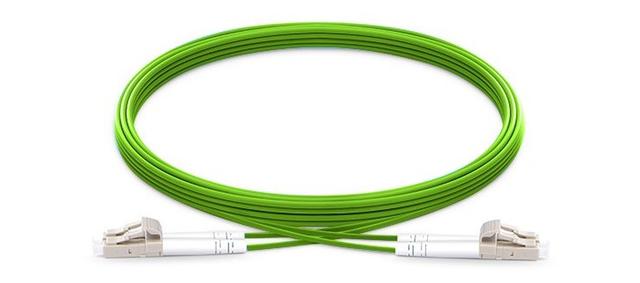
4) Fiber Optic Cables: High-frequency networking and the evolution of the fronthaul network under C-RAN are driving a substantial increase in demand for fiber optics on the wireless side. Meanwhile, the explosive growth in traffic is boosting demand for fiber optics in both the transport network and data centers. Currently, China’s backbone network bandwidth stands at 400G. With the advent of the 5G era, the expansion of application domains and the rapid surge in traffic are creating tremendous demand for higher bandwidth capacity and new network architectures—presenting both opportunities and challenges for optical networks. 5G has become a key driver for the expansion and upgrade of backbone networks. In the Tbit/s era beyond 400G, ultra-low-loss, large-effective-area G.654E fiber optic cables will demonstrate outstanding performance. Compared to traditional G.652 fiber, G.654.E fiber offers significant advantages in terms of electrical-repeater-free transmission distance, enabling longer spans of up to over 900 km without the need for repeater stations, while also exhibiting excellent resistance to microbending. Considering the overall costs—including those related to fiber optic cables, transmission equipment, and power consumption in central offices—this translates into substantial reductions in equipment investment and resource consumption costs. In the data center sector, the growing popularity of cloud computing, the rise of big data, the arrival of the 5G era, and the widespread adoption of artificial intelligence across various fields are all spurring transformative changes in the data center industry. Data centers are facing ever-increasing demands for bandwidth, and the construction of next-generation data centers calls for transmission media that are lower in cost and offer wider bandwidth. Against this backdrop, OM5 fiber and few-mode fiber are poised to become new growth drivers for the market.
5) RF Antennas: The application of MIMO multi-antenna technology across ultra-high-frequency and even millimeter-wave bands will lead to a sharp increase in demand for supporting components such as RF antennas, RF connectivity devices, and cables.
6) Small Cells: From the perspective of 5G deployment requirements, a network architecture combining “macro cells + small cells” will be adopted. Moreover, during the post-4G era, small cells will become the mainstream technology for indoor coverage and network optimization.
4) Fiber Optic Cables: High-frequency networking and the evolution of the fronthaul network under C-RAN are driving a substantial increase in demand for fiber optics on the wireless side. Meanwhile, the explosive growth in traffic is boosting demand for fiber optics in both the transport network and data centers. Currently, China’s backbone network bandwidth stands at 400G. With the advent of the 5G era, the expansion of application domains and the rapid surge in traffic are creating tremendous demand for higher bandwidth capacity and new network architectures—presenting both opportunities and challenges for optical networks. 5G has become a key driver for the expansion and upgrade of backbone networks. In the Tbit/s era beyond 400G, ultra-low-loss, large-effective-area G.654E fiber optic cables will demonstrate outstanding performance. Compared to traditional G.652 fiber, G.654.E fiber offers significant advantages in terms of electrical-repeater-free transmission distance, enabling longer spans of up to over 900 km without the need for repeater stations, while also exhibiting excellent resistance to microbending. Considering the overall costs—including those related to fiber optic cables, transmission equipment, and power consumption in central offices—this translates into substantial reductions in equipment investment and resource consumption costs. In the data center sector, the growing popularity of cloud computing, the rise of big data, the arrival of the 5G era, and the widespread adoption of artificial intelligence across various fields are all spurring transformative changes in the data center industry. Data centers are facing ever-increasing demands for bandwidth, and the construction of next-generation data centers calls for transmission media that are lower in cost and offer wider bandwidth. Against this backdrop, OM5 fiber and few-mode fiber are poised to become new growth drivers for the market.
5) RF Antennas: The application of MIMO multi-antenna technology across ultra-high-frequency and even millimeter-wave bands will lead to a sharp increase in demand for supporting components such as RF antennas, RF connectivity devices, and cables.
6) Small Cells: From the perspective of 5G deployment requirements, a network architecture combining “macro cells + small cells” will be adopted. Moreover, during the post-4G era, small cells will become the mainstream technology for indoor coverage and network optimization.
Friendship Links:


kolorapus (Shanghai) Communication Technology
Building 1, No. 351 Chengjian Road, Minhang District, Shanghai City